Background Check begins with a fast county‑level query that pulls arrest logs, court filings, and vital records into a single view, helping users verify identity and legal standing without chasing multiple agencies. By tapping into official sources such as the Bernalillo County Government office, the service respects permissible use rules and applicant consent requirements while delivering certified copies of public records, sealed‑record exclusions, and multi‑jurisdiction updates for a transparent background screening experience.
Background Check also guides users through correcting mismatched names or missing files, offering clear steps to request official agency copies and understand judgment orders, property filings, or marriage records. The platform highlights consumer rights under screening laws, explaining when consent is mandatory and how to navigate sealed or expunged data. This approach builds confidence for employers, landlords, and individuals seeking reliable background information online.
How to Search Background Check
A background check for Bernalillo County begins by naming the record type and the office that holds it. Arrest data, court cases, property filings, marriage records, business filings, and birth or death records come from different record systems. Records and updated birth records are frequently consulted when verifying active county cases. The Bernalillo County website provides a central starting point for locating county departments and their public-record services. Using official sources helps you confirm search results with a case number, court file, or certified copy.
Official Search Portal: https://www.bernco.gov/
Steps to Search
- Open the Bernalillo County website and find the department that holds the record.
- Select the correct record type, such as criminal, property, or marriage records.
- Enter the full legal name and any requested identifiers, such as a case number or date of birth.
- Apply relevant county, court, date, or case-type filters.
- Review the record’s case number, filing date, court, and current status.
- Check the final disposition to confirm the case outcome.
- Request a certified copy from the appropriate records custodian when needed.
Background Record Search
A background check is a collection of records linked to a person, not a single nationwide file. The search must match the right person, cover the right jurisdiction, and show the current status of each matter. The record owner listed below is the best place to confirm a result or request a copy.
Bernalillo County records cover matters handled by county and local agencies within that county, but they do not create a complete state or national history. A criminal case in another New Mexico county requires a search in that county’s court system. State agency records and federal court records also require their own sources.
Criminal, Court & Life Event Records
Criminal, civil, property, business, marriage, birth, and death records answer different questions. A criminal case can show alleged conduct and court actions, a property file can show ownership history, and a marriage file can confirm a recorded event. Each source must be read according to its own purpose, date, and access rules.
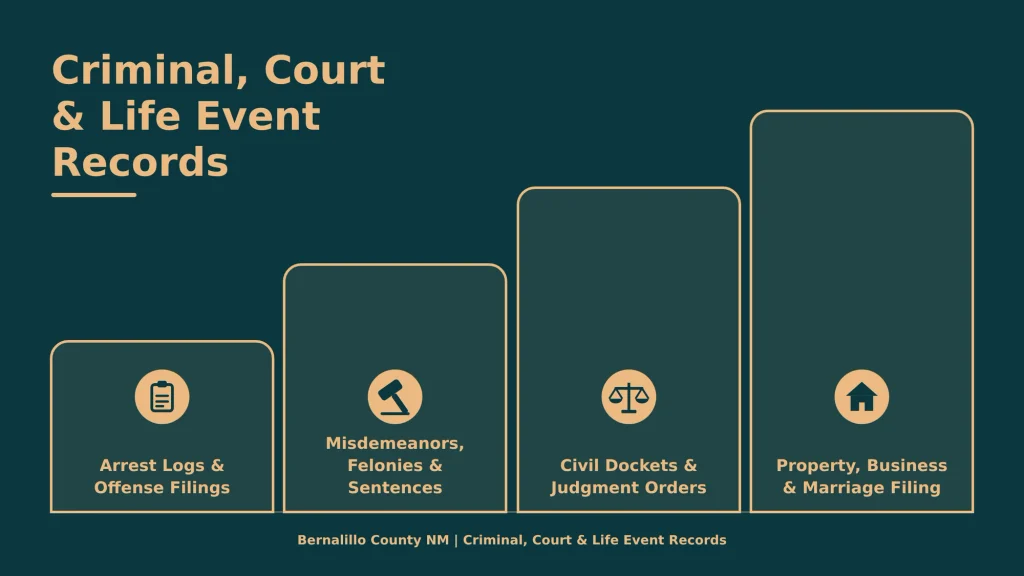
Arrest Logs & Offense Filings
An arrest log or criminal-history index may list the date of arrest, the agency involved, a booking number, and an alleged charge. It usually does not establish guilt or a final conviction. A separate court entry is needed to determine whether the person was charged, released, dismissed, convicted, or later received a different legal outcome.
Law enforcement incident reports, booking sheets, and inmate records can have separate access rules. A public case index may identify a case without releasing the full report. Under New Mexico’s Public Records Act, some law enforcement records may be withheld or redacted when a statutory exemption applies.
Misdemeanors, Felonies & Sentences
Misdemeanor and felony labels describe the type of charge brought against a person. They do not prove that the charge resulted in a conviction. A case may move from a complaint or citation through arraignment, plea, trial, sentencing, and appeal, with dismissal, acquittal, diversion, or deferred action also possible.
A sentence file may show fines, probation, community service, restitution, incarceration, or a mix of penalties. Read the disposition and sentencing entries together. A report that lists “charged” beside a case name can be misleading if another entry states that the charge was dismissed or the person was found not guilty.
Civil Dockets & Judgment Orders
Civil dockets cover disputes between people or businesses. Depending on the court, they may include divorce filings, debt claims, contract disputes, landlord-tenant cases, property claims, and requests for judgment. A civil case is not a criminal conviction, so a civil judgment should never be presented as proof of criminal guilt.
A judgment order may identify the parties, amount awarded, court costs, interest, payment terms, and lien rights. Later activity can include a payment, settlement, satisfaction of judgment, amended order, or appeal. The case number connects the docket entries with the judgment document, which helps verify that an amount or party name was not copied from another case.
Property, Business & Marriage Filings
Property records can show parcel details, assessed values, ownership transfers, and recorded liens. The Assessor and the Clerk/Recorder serve different functions, so one office may have the current parcel record while the other holds the filed deed or legal document. A name match by itself does not prove present ownership.
Business filings can show whether an entity is registered, its filing history, registered agent, and business address. Registration does not prove that the entity is active in every sense, and a filing may use a name that differs from the person’s everyday name. Search the exact entity name and check the filing number before requesting records.
Legal Compliance & Consumer Rights
A public record can still be subject to restrictions on who may use it and how a screening result may affect a decision. Checking official death index provides direct confirmation when evaluating public records. The rules depend on the record source, the reason for the search, and the type of decision being made. Checking those points before acting on a result helps prevent consent errors, discriminatory decisions, and the use of incomplete data.
Permissible Use & Screening Laws
When a third-party screening company assembles a consumer report for employment, housing, credit, insurance, or another covered decision, the federal Fair Credit Reporting Act generally applies. Section 15 U.S.C. § 1681b limits which records may be pulled for a permissible purpose and requires a permitted purpose for a consumer report. Public availability of a court record does not remove these use restrictions.
New Mexico also limits criminal-history screening in employment. NMSA 1978 § 13-1-7 generally bars private employers from asking about an applicant’s criminal history before making a conditional offer, subject to stated exceptions and other legal duties. Housing, credit, insurance, licensing, and volunteer screening can fall under separate federal or state rules.
Mandatory Applicant Consent Rules
Consent depends on how the search is performed. A request made directly to a government agency for a public record does not normally require the subject’s permission. A consumer report obtained from a screening company for an employment decision has different consent rules.
If a covered user takes adverse action based on a consumer report, 15 U.S.C. § 1681m requires notice that explains the right to dispute the report. The user should keep the screening disclosure, authorization, report, and decision notice together. That record shows that the permitted purpose, consent, and review steps were followed.
Official Record Correction Rights
A correction must start with the office that created the record. A report company can dispute data, remove data that it wrongly received, or update a report after receiving a corrected source file. It cannot erase an accurate court record because that record is unfavorable.
The Fair Credit Reporting Act also governs how furnisher corrections and consumer disputes are handled. Keep copies of every request and response. A written dispute creates a dated record of the issue, which is useful if the screening company or decision-maker continues to use the same incorrect entry.
Public Availability & Official Copies
Public access can take several forms. A search index identifies a case, an ordinary file copy provides the documents held by the agency, and a certified copy carries the custodian’s authentication. A summary page from a private service may contain less detail than any of them. The receiving agency or employer should state which form it accepts before you order records.
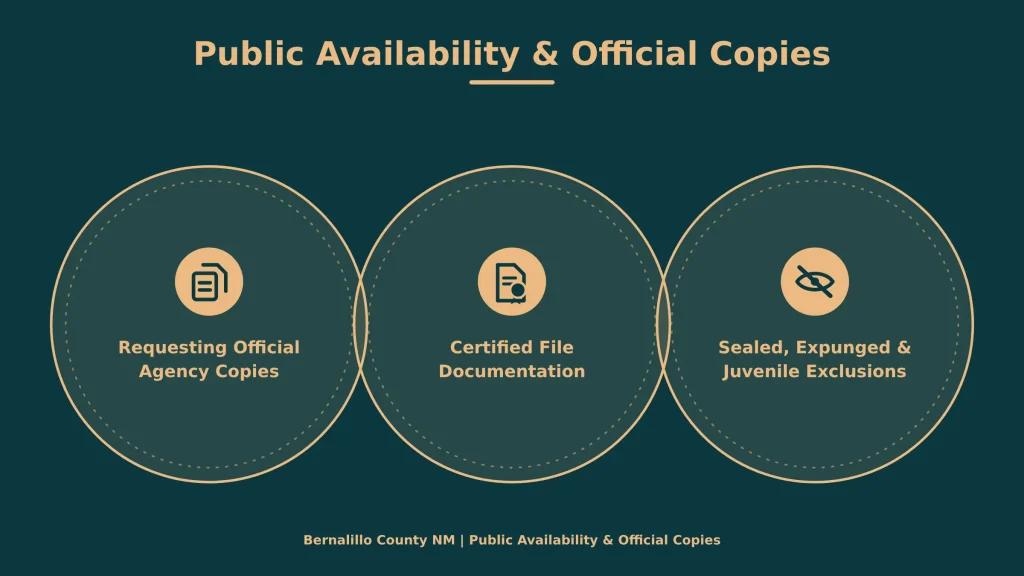
Requesting Official Agency Copies
For records held by a New Mexico executive agency, the Inspection of Public Records Act provides a written-request process. NMSA 1978 § 14-3(B) generally requires an agency to respond within 15 days after receiving a request for inspection or copies. Judicial records follow court rules and clerk procedures, so court files should be requested from the clerk handling the case.
A clear request should name the agency, describe each record, include the subject’s legal name, and list available identifiers such as a case number, parcel number, license number, date range, and event date. Under NMSA 1978 § 14-3(F), an agency may charge reasonable copying and transmission costs, while inspection itself carries no fee. A narrow request often costs less and produces a faster answer than a broad demand for every name match.
Certified File Documentation
A certified copy carries the seal, signature, or other authentication of the office that issued it. For a death index entry or other vital record, confirm whether the issuing office provides certified copies and what identification is required. Ask for a certificate page listing the custodian’s title, case or document number, issue date, and page count. A file labeled “certified” without proper authentication may not meet the requirements of a court, employer, landlord, insurance company, or immigration attorney.
Certification confirms that the custodian issued the attached document on the stated date. It does not certify that every statement inside a witness statement, report, or petition is true. For a court matter, ask for the docket and associated documents that matter to the decision, such as the complaint, answer, findings, judgment, sentencing order, or later amendment.
Sealed, Expunged & Juvenile Exclusions
Some files are unavailable to an ordinary public because a judge sealed them, a statute protects them, or a court order changed their status. A sealed case can appear in a case index while the documents inside remain closed. The court clerk can explain the visible status and the process for requesting access.
Juvenile records follow separate confidentiality rules, including the provisions in NMSA 1978 § 22-2-21. A routine adult background search should not expose protected juvenile records. Other files may redact victim identifiers, private addresses, medical details, or other material protected by law. A report’s failure to show restricted material may be lawful rather than an error.
Record Accuracy & Resolution
Accurate screening depends on two checks: matching the correct person and verifying the current source file. A list of hits can still be wrong if names, dates, addresses, or case numbers are attached to another person. Record problems are easier to resolve when each discrepancy is tied to a specific field and source.
Separating Similar Name Matches
Shared names are common, and civil cases may contain more than one person with the same surname. A name-only result can join records from different counties, family relationships, or business entities. Each result should be checked against fields that are less likely to be repeated.
If a court index does not show a date of birth, the clerk may still be able to match a file using the name used at the time, the case number, event date, and party role. Do not merge two cases solely because the names match. Ask the source office which identifiers appear in the official file.
Multi-Jurisdiction Reporting Delay
Record sources do not refresh on the same schedule. A clerk may docket a case before it reaches an online index, while a judgment may be entered before a report company receives the updated file. A later sealing or expungement order also takes time to reach every database that holds a copy.
Commercial reports may carry a stated “as of” date, but that date does not control the court’s current record. The court docket remains the best source for case status. For a matter that recently moved from arrest to filing, or from conviction to sentencing, check the case number directly with the clerk.
Unlisted Background File Resolution
A missing result can come from a narrow filter, a name change, a different jurisdiction, an indexing error, or a lawful restriction. Start with the case number when one is known. If no number is available, document the exact name and date range used before changing the search.
A screening result is a finding aid, not the final record. The strongest resolution combines the original search terms, the source docket, a case number, and a written status from the custodian. That record can then be used to correct a report or support a decision without relying on a name-only match.
Contact Details
For questions about county records, office services, or record request procedures, contact the Albuquerque/Bernalillo County Government Center during regular business hours. Confirm the correct department and any document requirements before visiting.
Frequently Asked Questions
Background check services let you verify a person’s legal history, address history, and public records. Using official sources such as Bernalillo County ensures accurate results and protects you from fraud. Quick searches help landlords, employers, and individuals make informed decisions while staying within legal limits.
How can I perform a background check in Bernalillo County by name?
Start at the Bernalillo County website and locate the “Public Records” section. Choose the record type—arrest, court, or property—and enter the full name. The system returns case numbers, filing dates, and status. Note the case number to request full documents at the County Clerk’s office or via mail. This approach guarantees official data and avoids third‑party fees.
What steps are needed for a background check search using a date of birth?
Visit the county’s online portal and select “Search by DOB.” Input the exact birth date and, if possible, the middle name to narrow results. Review the list of matches, then click each entry to see associated records such as criminal filings or property deeds. Record the case numbers for any items you need to verify in person.
Can I look up background check records by address in Bernalillo County?
Yes. Use the “Address Search” tool on the county site. Type the street address, then review linked records like tax parcels, eviction filings, and court cases. This method helps landlords confirm tenant histories or neighbors check property disputes. Save the parcel ID for any deeper investigation at the Recorder’s Office.
What is the best way to conduct a background screening for employment?
Employers should request a written consent from the applicant. Then, use the county’s official portal to search criminal and court records by name or DOB. Compile case numbers, verify outcomes, and compare them to the job’s requirements. Keep the consent form and search results for at least five years to meet compliance standards.
How do I obtain public records background check information for a specific county search?
Identify the relevant department—Sheriff’s Office for arrests, District Court for filings, or Assessor for property. Each department offers an online lookup or a phone line. Provide the person’s name, DOB, or address, then note the case numbers returned. For full copies, submit a request form to the appropriate office, include any required fees, and pick up the documents during business hours.